Unit 3: Geometry
A comprehensive summary of Unit 3 lessons with examples and various applications
1. Types of Angles
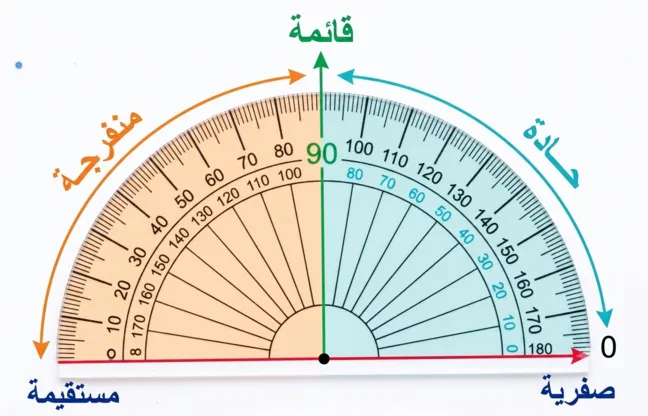
Measuring different types of angles using a protractor
Acute
Greater than \(0°\) and less than \(90°\)
Right
Equals \(90°\)
Obtuse
Greater than \(90°\) and less than \(180°\)
Straight
Equals \(180°\)
Reflex
Greater than \(180°\) and less than \(360°\)
Example:
If \(m(\angle A) = 50°\), then the corresponding reflex angle is:
2. Relationships Between Angles

Two complementary angles
Their measures add up to \(90°\)
Measure of angle \((A) = 90° - m(\angle B)\)
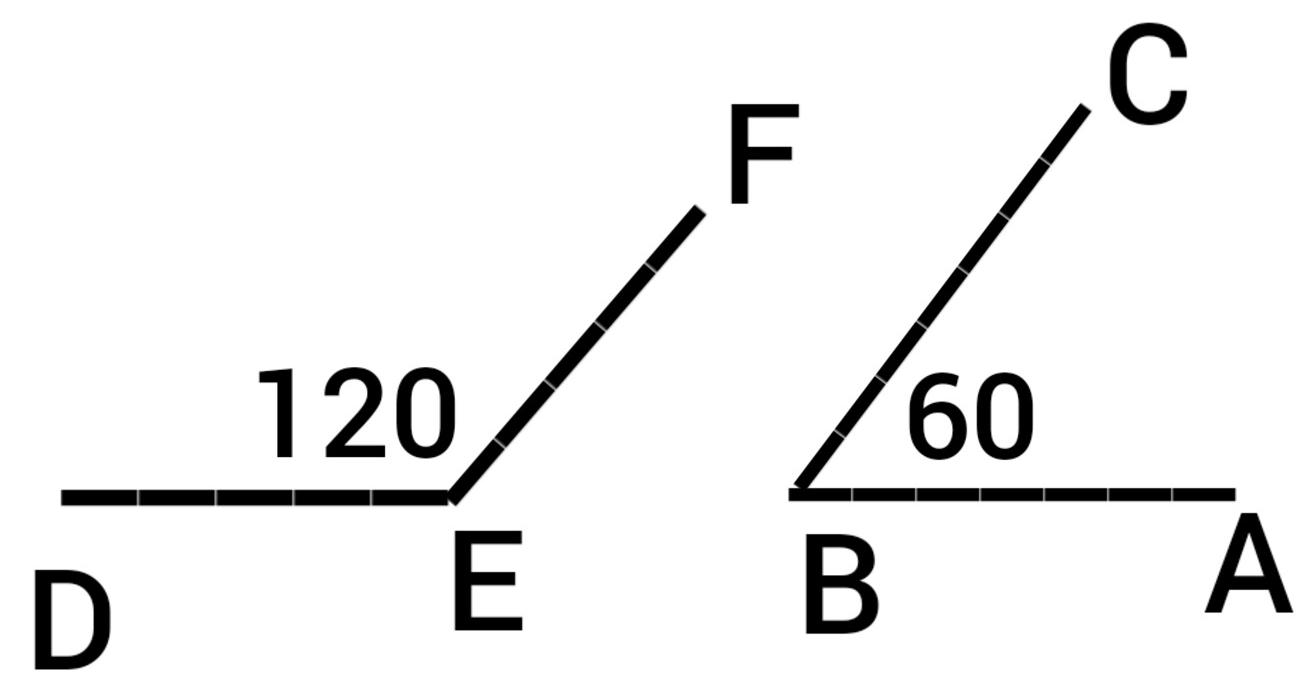
Two supplementary angles
Their measures add up to \(180°\)
Measure of angle \((A) = 180° - m(\angle B)\)
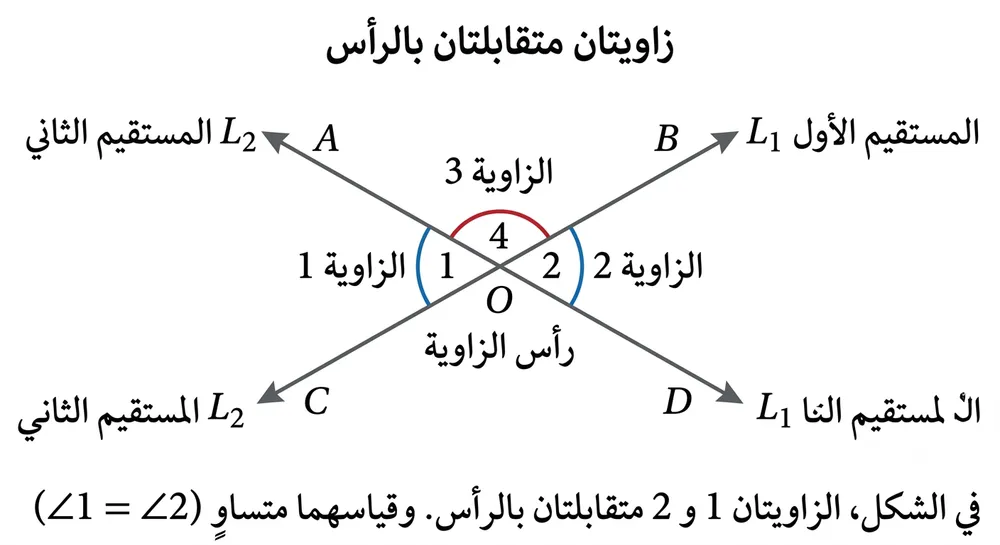
Vertically opposite angles are congruent (equal in measure)
Example:
If \(m(\angle 1) = m(\angle 2)\) (vertically opposite), and \(m(\angle 1) = 36°\), then the measure of its complement is:
3. Angle Bisector and Angles Around a Point
Angle bisector:
It is the ray that divides an angle into two angles of equal measure.
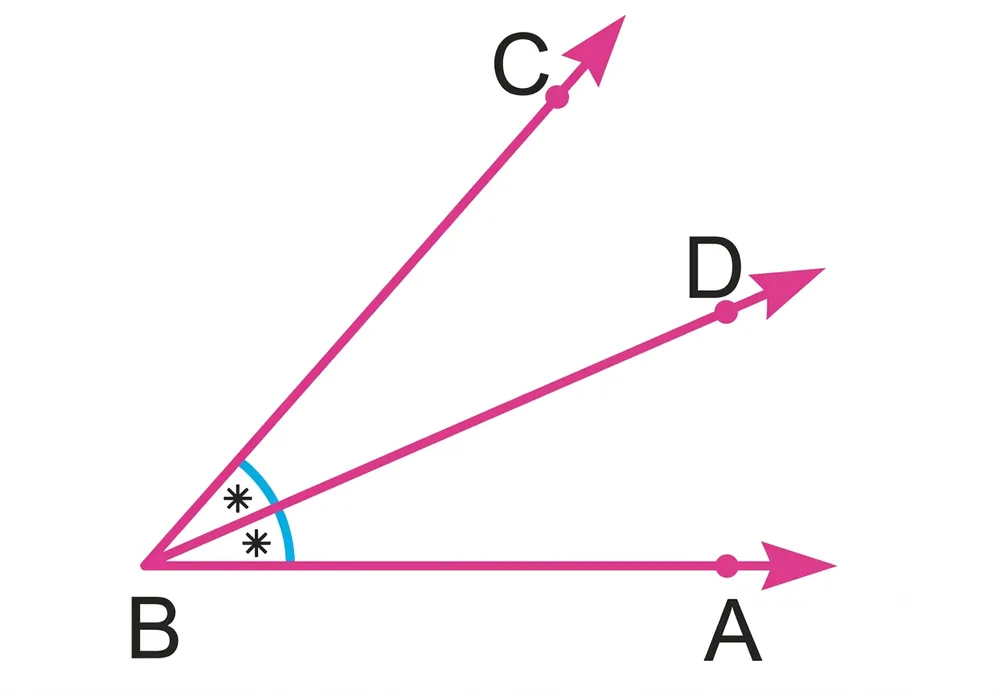
\(BD\) bisects \(\angle ABC\)
Angles around a point:
The sum of the measures of the angles around a point equals \(360°\).

Angles around a single point
Example:
Find \(m(\angle AMB)\) if the remaining angles around the point are \(90°, 87°\):
4. Parallelism
When two parallel lines are intersected by a transversal, eight angles are formed, and the following relationships arise between them:

Parallel lines AB and CD intersected by transversal EF
Interior angles on the same side
Supplementary (sum is \(180°\))
Exterior angles on the same side
Supplementary (sum is \(180°\))
Alternate interior angles
Equal in measure
Alternate exterior angles
Equal in measure
Corresponding angles
Equal in measure
Example (1):
\(AB \parallel CD\), find the values of \(x, y\):

Illustrative figure for the example
Example (2) Proving parallelism:
Prove that \(AB \parallel DC\):

Illustrative figure for the proof
Since two interior angles on the same side are supplementary \(\therefore AB \parallel DC\)
5. Sum of Interior Angles of a Polygon

Note that each time the number of sides of a polygon increases by one, the sum of the measures of its interior angles increases by \(180°\)
Triangle: \(180°\)
Quadrilateral: \(360° = 180° \times 2\)
Pentagon: \(540° = 180° \times 3\)
Hexagon: \(720° = 180° \times 4\)
Heptagon: \(900° = 180° \times 5\)
General formula:
where \(n\) is the number of sides of the polygon
Example:
Find the value of \(X\) in the quadrilateral \(ABCD\):

Illustrative figure for the example
Measure of each interior angle of a regular polygon:
Square or rectangle
\(90°\)
Regular pentagon
\(108°\)
Regular hexagon
\(120°\)
Equilateral triangle
\(60°\)
6. Exterior Angle of a Triangle and Triangle Inequality
Exterior angle of a triangle:
The measure of an exterior angle of any triangle equals the sum of the measures of the two non-adjacent interior angles.

\(m(\angle ACD) = m(\angle A) + m(\angle B)\)
Example:
In triangle \(ABC\), the exterior angle at \(C\), if \(m(\angle A) = 22°\) and \(m(\angle B) = 82°\):
Triangle inequality:
The sum of the lengths of any two sides of a triangle is greater than the length of the third side.

Condition for three lengths to form a triangle
\(3, 4, 5\) cm
Valid (since \(5 < 3+4\))
\(7, 2, 3\) m
Invalid (since \(7 > 2+3\))
\(12, 6, 6\) cm
Invalid (since \(12 = 6+6\))
7. Parallelogram Quadrilaterals
Properties of a parallelogram:
- Each pair of opposite sides are parallel and equal in length.
- Each pair of opposite angles are equal in measure.
- The diagonals bisect each other.

Parallelogram ABCD
Special types of parallelograms:
Rhombus
Its four sides are equal in length, and its diagonals are perpendicular.
Rectangle
Its four angles are right angles, and its diagonals are equal in length.
Square
Combines the properties of both the rhombus and the rectangle.

When is a quadrilateral a parallelogram, rhombus, rectangle, or square
8. Coordinates: Midpoint of a Line Segment

Midpoint of the line segment \(AB\)
Midpoint formula:
If \(A(x_1, y_1)\), \(B(x_2, y_2)\), then the midpoint of \(\overline{AB}\) is the point \(M\) where:
Notes:
- If the two points lie on one of the axes, then their projection on it is themselves, and their projection on the other axis is the origin.
- The projection of the line segment \(AB\) on the \(X\)-axis: \(A', B'\) are the projections of \(A, B\) respectively.
- If a line segment is parallel to the \(Y\)-axis, then its projection on it equals its length.
Example:
\(ABCD\) is a quadrilateral with \(A(-3, 2)\), \(D(1, 4)\), \(C(5, 4)\), \(B(7, 6)\). Prove that \(ABCD\) is a parallelogram by finding the midpoints of the diagonals:
If the midpoints of the two diagonals coincide, then the shape is a parallelogram (verify the coordinates used before relying on the result).